
News & Insights
What replaces consultation by default?
tCI will be publishing its position paper in response to the Cabinet statement of 31 July 2026. Government should build a replacement before dismantling the safeguard. Click here to receive a copy of our upcoming paper.
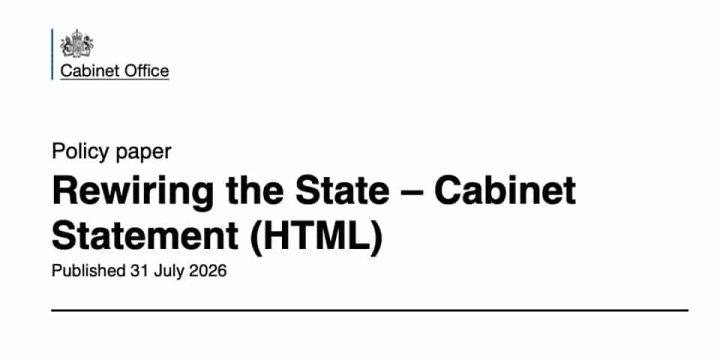
On 31 July the Cabinet Office published Rewiring the state, a programme moving power from Whitehall to mayors and strategic authorities in England. Most of it concerns devolution. Three sentences in the section on central government concern everyone working in public involvement and. participation.In that section government agreed:
- to do so on the basis that local leaders are better equipped to link public opinion and civil society to policy making
- to replace consultation by default with new and modern forms of public participation
- to consider where performative statutory duties to consult (central government) can be revoked
The government plans to cease treating consultation as a routine public involvement method, considering repealing some legal duties requiring it, but has not specified what will replace it.
Whose duties are in view is not yet clear | On its placement, the passage is about departments and arm’s-length bodies, and that is The passage discusses departments and arm’s-length bodies, and that is our current understanding of its scope.
However, the language is deliberately broad: only Parliament can revoke a statutory duty, and just a week before the statement, the government began repealing consultation duties imposed on infrastructure applicants, who are not included. Until the white paper clarifies its scope, organisations outside central government, in our opinion, cannot assume they are unaffected.
Our Response
We support the diagnosis | Consultations that do not impact the decision should be ended. Practitioners who attend our Coffee Mornings and support local engagement and consultation have an acute awareness of this and work actively with their communities to involve them in decisions.
Our concern is its sequence | Modern public participation is undefined. The statement does not say which duties it regards as performative, who decides whether participation is required, or how the replacement will be funded and assured. The specialist workforce expected to deliver it is contracting (again another theme of our Coffee Morning), and the white paper that settles all of this is due this autumn alongside the Budget.
What the paper does not address is that revoking a duty also does not remove the surrounding legal framework. The public sector equality duty survives, and other routes to a duty to consult survive where they can be established on the facts. What revocation removes reliably is the standardised process that generated the evidence for the duties that remain.
What we are doing | The tCI team, lead by Andy Wright, Barry Creasy and Dr Zoë Cookson are currently drafting our position paper setting out what we think the statement means, what should not be inferred from it and the questions the white paper needs to answer. It will propose a model: move from consultation by default to participation by design, and keep consultation where openness, legal fairness, rights or broad public scrutiny are required.
The paper will be published shortly. Click the link to register your interest, and we will send it to you: Click Here

Simon Angelides
More news

The Consultation Institute’s 2026–27 public virtual training programme is now open for registrations of interest. 41 courses run from 16...
tCI will be publishing its position paper in response to the Cabinet statement of 31 July 2026. Government should build...